
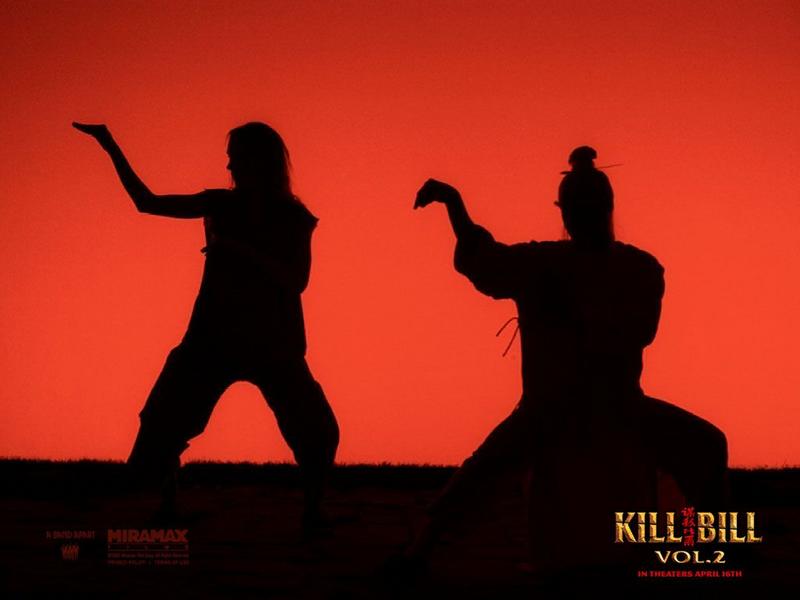
“That woman deserves her revenge. And we deserve to die.”
Let us disregard morality for a while. Let us not weigh whether it was wise for Beatrix Kiddo to kill Vernita Green within arm’s reach of her four-year-old’s cereal bowl. Let us not ask whether the Bride is righteous or redeemable. Leave those questions outside the theatre door, and what remains is a drawn blade moving through the film: a mother robbed of her child, awake after four years of enforced darkness, and burning with a rage that doesn’t negotiate. She is every betrayed woman’s private wish for the world to finally, loudly, bleed back.
While the film is narrated non-linearly (as all the best stories are), linearly-speaking, Kill Bill begins with Beatrix being shot in the head at her wedding rehearsal, her unborn baby seemingly killed with her, by Bill and the Deadly Viper Assassination Squad, who were once her comrades. She wakes from a coma to find her womb empty, her body exploited, her life erased, and she responds in the only language her world has ever respected: a kill list. Written in black and red marker, it goes – O-Ren Ishii, Vernita Green, Budd, Elle Driver, and finally, Bill.
Bill is the leader of the Deadly Viper Assassination Squad, and also Beatrix’s former mentor and lover. In the film, he is both absent and everywhere, a device that Tarantino uses to turn him into the mythic endpoint of the whole story: it’s called Kill Bill, not The Bride’s Revenge. He is mostly off-screen, often a voice on the phone issuing instructions than a presence we can study. Despite his late appearance in the movie, his presence is felt throughout, monitoring Beatrix’s progress from a distance, weighing her each kill with the cool authority of someone who once trained her. And as she works through the list toward his name, he becomes the final threshold: the last person she has to face before the story can end and her life can begin again.
In Xavier Morales’ review of Quentin Tarantino’s Kill Bill, Vol. 1, entitled “Beauty and violence”, he calls the film “a ground breaking aestheticization of violence.” Morales says that the film, which he calls “easily one of the most violent movies ever made” is “a breath taking landscape in which art and violence coalesce into one unforgettable aesthetic experience”. Not only does this aestheticization help the viewer ignore their moral concerns while viewing the movie, it also comes in different shades. The Bride is the one constant in each conflict, while her sparring partner defines the aesthetic of the fight scene, and Beatrix adapts accordingly. From Vernita Green’s domestic home with gaudy primary colours to the sepia desert which is the background to Budd’s trailer. The sharpest contrast however, is when the Bride faces Gogo and O-Ren Ishii.
The fight with Gogo Yubari, with her juvenile cruelty and schoolgirl’s grin, is all blunt impact and bright red blood. The blows land close and ugly and you feel the film pressing your face into the brutality of it, daring you to flinch but you still keep watching. But when the Bride reaches O-Ren Ishii, the movie changes its tune. The House of Blue Leaves transforms, and the snow garden becomes a temple – negative space, clean lines, and moonlight so careful it feels composed by a calligrapher. If the Gogo sequence is splatter‑punk, the O‑Ren duel is a ceremony. One is a brawl that stains everything it touches, while the other is violence refined until it resembles beauty, and the red on the snow looks less like gore and more like ink on Khadi paper.
The Bride goes through the kill list and finally arrives at Bill’s home, unaware that her daughter is still alive. She sees that BB (Beatrix-Bill??) has been raised not as a hostage but as a bright, loved child and happy enough to accept a bedtime myth that her mother is merely sleeping, dreaming of her every day. The three spend an evening together having dinner and watching a movie, and one can’t help but wonder if it is not Bill and Beatrix playing a fantasy that each has always craved.
After BB goes to sleep, Bill shoots Beatrix with a dart tipped with sodium pentothal. Under the influence of the truth serum, the two ex-lovers, ex-mentor-mentee, have an honest conversation. They admit to each other what they are, what they did, and what it cost. She confesses that she enjoyed every kill that it took her to get to him. Bill on the other hand, confesses that he acted out of anger because she broke his heart. Simultaneously, he realises that they have come a full circle, and now it is his turn to face Beatrix’s anger.
The fight scene between Bill and Beatrix is unlike any in the film and is almost anti-climactic because you don’t get the operatic sword duel the film so far has trained you to expect. Beatrix kills Bill with the Five Point Palm Exploding Heart Technique – something she learnt from her former mentor Pai Mei. Bill studied under Pai Mei too, and was in fact one of his most talented pupils, but was never taught the Five Point Palm Exploding Heart Technique. With Beatrix though, Pai Mei doesn’t merely train her – he is conquered by her stubbornness combined with her devotion and respect, and she is the only one besides Pai Mei himself to know the Five Point Palm Exploding Heart Technique. There is something very special in the relationship between Beatrix and Pai Mei, in the midst of this world where once lovers and friends turn mortal enemies. So, when Elle Driver boasts of poisoning Pai Mei and killing the old master with contempt disguised as cleverness, it isn’t just revenge that flares in Beatrix. It is loyalty that is almost filial. When Beatrix plucks out Elle’s remaining eye, it isn’t just another violent scene in the movie. It is the fury of a student whose teacher was murdered by another who never deserved the title. And when she uses Pai Mei’s technique on Bill, never once having revealed it to him that she was taught it, she seals the film’s deepest betrayal. Bill thought he authored her, but Pai Mei helped rewrite her. And Beatrix kept the final line for herself.
The Five Point Palm Exploding Heart Technique lands as a narrative knife, not a choreography flex. Bill, who was heartbroken once before assuming that Beatrix had left him for someone else, now has his heart broken (quite literally) once more, when he realises that Beatrix never revealed to him that Pai Mei had taught her the technique. And Bill finally sees that Beatrix is a superior killer than him in every way. After she kills Bill, Beatrix leaves with BB not as a victorious gladiator, but as a living mother in a world still (almost) intact. She leaves not as the Bride or the Black Mamba, she leaves as Mommy.
“You’re not a bad person. You’re a terrific person. You’re my favourite person, but every once in a while, you can be a real cunt.”
 Golden Ruley