
A beginner-friendly, end-to-end regression pipeline for chemists
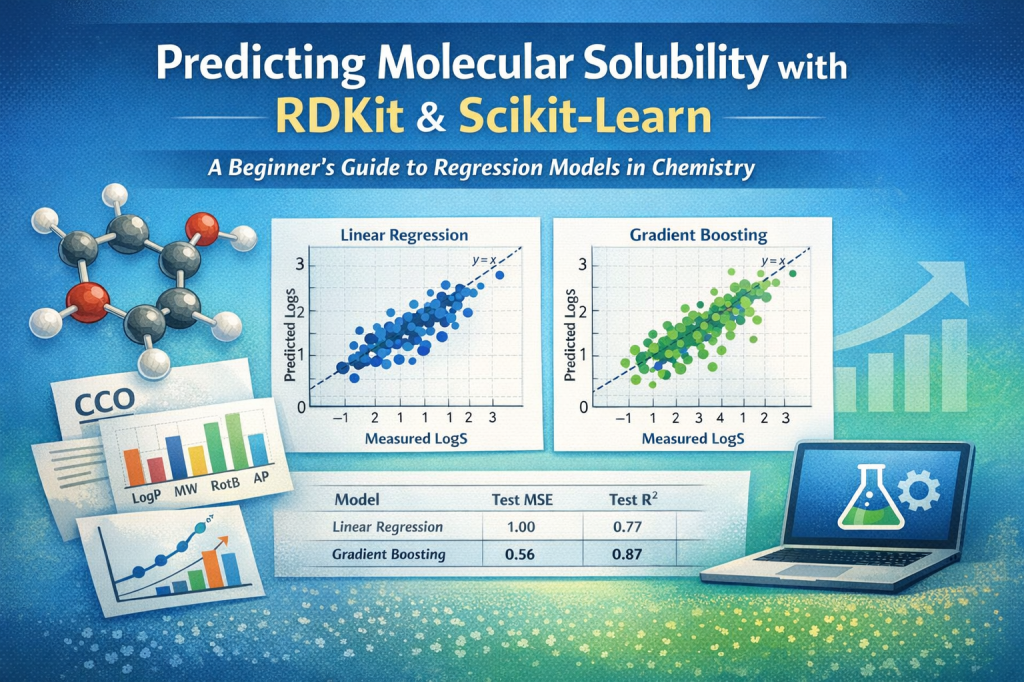
If you’ve done some chemistry (maybe even a bit of cheminformatics) but you’re new to machine learning, molecular solubility is a really nice first ML project: the problem is meaningful, the features are interpretable, and you can build a full pipeline without drowning in theory.
In this post, we’ll build an end-to-end machine learning pipeline that:
- reads a dataset of molecules + measured solubility
- turns SMILES into RDKit molecules
- computes a small set of chemical descriptors
- splits data into train/test sets
- trains multiple regression models
- evaluates them using MSE and R²
- compares models (simple → more powerful)
We’ll use Linear Regression as a benchmark baseline and then see why a Gradient Boosting Regressor often wins for this kind of structure-property prediction.
Where does this problem fit in machine learning?
Supervised learning
This is a supervised learning problem because we have:
- inputs (X): descriptors computed from molecule structures
- outputs (y): experimentally measured solubility values
The model learns a mapping from descriptors → solubility based on labeled examples.
Regression (not classification)
This is specifically a regression task because solubility is a continuous number (e.g., logS).
To contrast:
- Regression: predicts a number
- “What is the solubility of this molecule?” → 1.23, −2.7, etc.
- Classification: predicts a category
- “Is this molecule soluble?” → soluble / not soluble
- or “Which solubility class?” → low / medium / high
In classification you evaluate things like accuracy or F1 score. In regression you evaluate numeric error (like MSE) and variance (like R²).
The dataset and our features (descriptors)
We start with a table containing at least:
- SMILES strings
- measured solubility (our target
y)
Then we compute a small set of interpretable descriptors from RDKit. In the classic ESOL/Delaney style setup, a common set includes:
- MolLogP: estimated lipophilicity
- MolWt: molecular weight
- NumRotatableBonds: flexibility proxy
- Aromatic Proportion (AP): fraction of aromatic atoms in the molecule
These are not “magic ML features” – they’re chemical properties we can reason about.
Train/test split: why we do it
We split the dataset into:
- training set (80%): used to learn the model parameters
- test set (20%): used only at the end to evaluate how well the trained model generalizes
This is the core discipline in supervised ML: train on one set, evaluate on unseen data.
How we evaluate models: MSE and R²
We use two common regression metrics.
1) Mean Squared Error (MSE)
MSE measures the average squared difference between true and predicted values:
- Lower is better.
- Squaring makes large errors hurt more (outliers matter).
- Units are “solubility units squared” (e.g., logS²), so it’s more of an optimization metric than an intuitive one.
2) Coefficient of Determination (R²)
R² answers: how much of the variance in y does the model explain compared to a dumb baseline that always predicts the mean?
- 1.0 is perfect.
- 0.0 means “no better than predicting the mean”.
- Negative means “worse than predicting the mean” (yes, that can happen).
How to use them together
- MSE tells you how wrong you are on average.
- R² tells you how much structure you captured in the data.
For beginner workflows, reporting both is a nice balance.
The models (ordered from simplest to more advanced)
We’ll go in a gentle progression: start with the simplest baseline and then try models that can represent more complex relationships.
1) Linear Regression (the benchmark)
Linear Regression assumes solubility is a weighted sum of your descriptors:
Why it’s a great beginner baseline:
- fast
- interpretable coefficients
- you can compare coefficients to literature (very satisfying in chemistry!)
It also gives you a reference point: any “fancier” model should beat this baseline on the test set to justify complexity.
2) Ridge Regression (Linear Regression + stability)
Ridge is still a linear model, but it adds a penalty for large coefficients:
This “shrinks” coefficients and can help when descriptors are correlated or noisy. Conceptually, it’s Linear Regression that’s a bit more cautious.
3) Lasso Regression (Linear Regression + feature selection)
Lasso uses a different penalty:
This can push some coefficients exactly to zero — basically doing a simple form of feature selection.
With only four descriptors, feature selection isn’t the main story, but it’s still useful to see how regularization changes behavior.
4) Elastic Net (L1 + L2 combined)
Elastic Net blends Ridge and Lasso:
- When you want some sparsity (L1) and stability (L2), Elastic Net is a nice compromise.
5) Gradient Boosting Regressor (often the winner)
Gradient Boosting is where we step beyond “one equation” and start building a model that can represent non-linear structure.
The intuition:
- you build many small decision trees (weak learners)
- each new tree tries to correct the mistakes of the previous ones
- the final prediction is a sum of these trees
This matters because molecular properties often have non-linear relationships:
- the effect of logP on solubility might depend on molecular weight
- aromaticity might matter differently depending on flexibility
- there may be thresholds, interactions, and curved trends that a straight line can’t capture
Linear regression draws a plane through descriptor space. Gradient boosting can carve up the space into regions and learn piecewise rules.
Why Linear Regression is the benchmark (and why Gradient Boosting often does best)
Linear Regression as a benchmark
Linear Regression is the perfect “benchmark” model because:
- it’s easy to understand
- it’s quick to train
- it gives you interpretable coefficients tied to chemistry
- it sets a baseline for performance
If a more complex model doesn’t beat it on the test set, it’s probably not worth it.
Why Gradient Boosting wins here
In solubility prediction, the relationship between a handful of descriptors and logS is rarely perfectly linear. Gradient Boosting tends to outperform because it can learn:
- non-linearity (curves, thresholds)
- feature interactions (A matters differently depending on B)
- piecewise behavior (different regimes of chemistry)
So it’s common to see:
- Linear Regression doing “pretty well” (good baseline)
- Gradient Boosting squeezing out better test performance because it can model richer relationships without you manually engineering interactions
What makes this an “end-to-end” pipeline?
A lot of beginner ML tutorials start at “here is X and y” and skip the chemistry part.
This pipeline is end-to-end because it includes the whole journey:
- SMILES → RDKit molecules
- Molecules → descriptors
- Descriptors → train/test split
- Training multiple models
- Evaluating with MSE and R²
- Comparing models and choosing the best
That’s the backbone of most real applied ML projects — not just solubility.
Closing thoughts
If you’re a chemist learning ML, you’re in a great position: you already understand the domain knowledge behind the data. Even a simple descriptor-based regression pipeline can teach you a ton about the ML workflow – and it’s surprisingly useful in practice.
 Golden Ruley